Career-Connected Learning
Time to Thrive Conversations
GROWING MORE OPPORTUNITIES FOR YOUTH SUCCESS
The Wyoming Enrichment Network and other organizations presented the Time to Thrive conversation series during the fall of 2025 to inspire and connect adults who work with or engage young people grow in after school, on weekends, during the summer, and in every space where learning happens. Together, we explored how organizations and adults can deepen developmental relationships, build adult capacity to mentor and inspire youth, and create connected, career-relevant pathways.
Time to Thrive Conversation Series: Elevating Youth Voice in Local Decision-Making
By Aria Heyneman for the Wyoming Enrichment Network
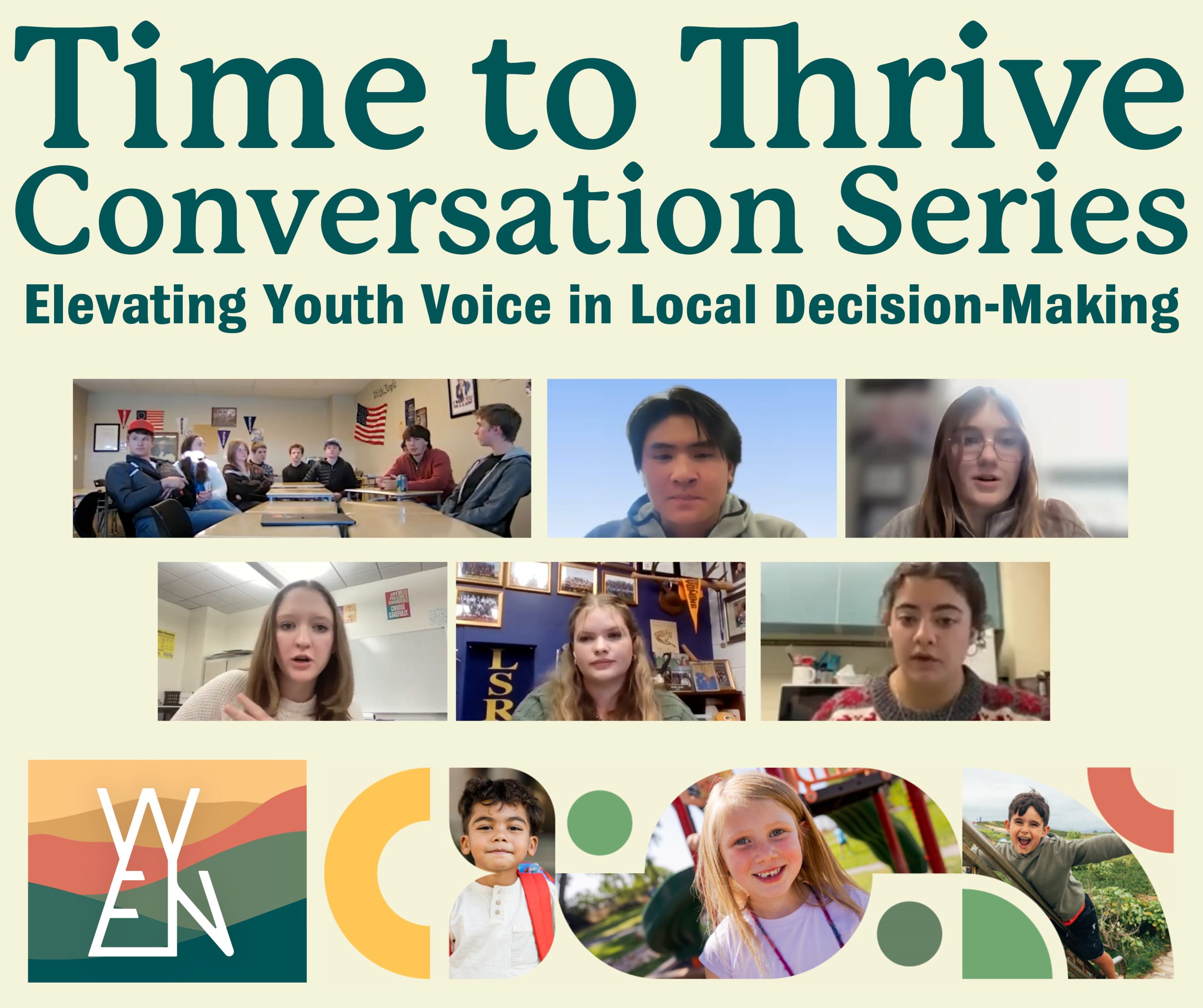
On Tuesday, Dec. 16 at 11 a.m., the Wyoming Enrichment Network (WYNE) Time to Thrive Conversation Series continued its last of four webinars: “Elevating Youth Voice in Local Decision-Making.”
WYEN Director Michelle Sullivan introduced the Time to Thrive campaign to participants, including the goal of connecting Wyoming’s young people’s learning by building partnerships across communities.
“We know, at the Enrichment Network, that learning happens everywhere. It doesn’t just happen in schools. Our commitment is to make sure there are accessible, rich experiences for young people wherever they learn,” – Michelle Sullivan
In the final conversation of the webinar series, young people from around the state of Wyoming shared their experiences and perspectives on how youth can be better supported as they grow into meaningful contributors to our state and society.
Youth panelists made up a wide range of geography, organizations and ages. Panelists included:
- Hung, freshman at Sheridan High School, representing Sources of Strength Club
- Maeve, student at Little Snake River High School in Baggs, Wyoming, representing 4H
- Abby, senior at University of Wyoming, alum of summer STEM program
- Ellie, freshman at Douglas High school, representing STEM Next program
- Juniors and seniors from Laramie High School’s We the People team
- Ally, senior at Pinedale High School, representing the state 4H team
The following are highlights from the Q&A between Sullivan and youth panelists:
What opportunities do you need to contribute to Wyoming communities, both now and in the future?
- Participation in school, government and community boards to share youth opinions
- Earlier access to opportunities like internships, job shadowing and mentorships for middle and high school students, especially in fields like health care, engineering, and business
- Facilitated connections to industry leaders within communities
- More community events and activities for youth
- More physical spaces for youth to gather and create meaningful connections
What strengths do you as young people have that can make a difference in local decision-making?
- Ambition, energy, excitement about the future
- Knowledge and familiarity with social media, an increasingly prevalent piece of popular discourse and widescale marketing
- Experience with the school system, mental health challenges and social pressures in real time
- Skills of problem-solving and adapting
- Open-mindedness
- Time!
“An investment is needed in the young people in Wyoming. We need some sort of investment to get us to stay here,” – Laramie High School We The People student
What questions do you wish adults were asking of young people in Wyoming?
- What challenges are you facing that adults might not see?
- How can we better manage our natural areas in Wyoming?
- How can we provide better access to outdoor recreation and our wilderness areas?
- What does success look like for you? How can we support you to find that success in adulthood?
- How connected do you feel to your local community?
- What is your opinion on __?
- What opportunities do you need in high school to start exploring future careers?
How would you like to be involved in local decision-making and what help do you need from adults to make that happen?
- Attendance / representation at county commissioner and school board meetings
- Funds allocated to student councils across the state, ways to participate in spending money and making meaningful decisions
- Someone to open the door to leadership opportunities and take us seriously
- Adults not underestimating youth in Wyoming, providing opportunities for youth to get their voices heard
- Pathways to express ourselves and people willing to listen
“Adults need to stop assuming that we are too young to contribute. When young people are trusted with responsibility, their voices stop being opinions and start becoming direction.” – Hung To
As the webinar wrapped up, several participants shared their appreciation of the remarks from youth on the webinar, including Diana Clapp, State Board of Education Coordinator, Mary Louise Wood of the University of Wyoming Extension and Laura Dale, Public Engagement Coordinator at the Sweetwater County Historical Museum.
In an effort to expand on the topics discussed throughout this conversation, I followed up with Hung To, freshman at Sheridan High School. Below is an additional Q&A with Hung which expanded on themes touched on during the Time to Thrive webinar.
Aria: How can we better support the professional development of youth in Wyoming before they begin to look for opportunities elsewhere?
Hung: I wish there were more mentorship and career-exploration resources teens could easily connect with to learn about real jobs in Wyoming and how to prepare for them. I also wish there were more hands-on opportunities, like internships, service projects, or leadership training, that are open to all students (beginning 6th grade year), not just a few who already know where to look. And finally, I wish there were more youth-centered spaces and support systems, especially around mental health and civic engagement, where young people feel comfortable asking questions, making mistakes, and being taken seriously; not being excluded.
A: What does success look like for you?
H: Success, to me, is using my skills to make a real difference in the place that raised me. It means being trusted with responsibility and knowing my voice helps move decisions in the right direction. And it looks like growth, not just personal achievement, but progress I can see reflected in my community.
A: How can adults better support the development of youth from their high school years and into college?
H: Support kids’ voices in decision making, recognize that some kids are more mature than others, exposing them to the reality of future initiative rather than holding them back, provide the support and resources that youth will need to be successful, reach out to local councils, civic related non-profits, and schools to ask about youth involvement and why. And most importantly listen and understand that we are the next generation. Without us there will be no future.
A: What kind of platforms should youth voices hold to share the perspective of young people?
H: Youth need to have a voice at the table through representation on all levels of decision making – school board members (great idea, already seen at Green River), city council, county task force members, advisory group members. Even though you may start off with “advisory” status, the reality is that when youth are present in the room for the first time, they are able to express their views prior to finalizing any decisions rather than having those views considered only after decisions are made. From my idea, youth councils must be created in each area with direct ties to local leaders; these will only be effective if youth receive feedback from their input and understand where their input is going and how it’s being utilized otherwise they will only feel symbolic, feeling like they haven’t done any impact in improving the community/region/town.
Schools represent one of the largest opportunities to engage youth in decision-making processes and currently are largely unutilized. Student councils, clubs can be organized to gather youth input and submit this input to decision makers. All youth must be given equal opportunity to share their voices via public forums (town hall meetings, listening sessions, community forums) where youth have the opportunity to speak side by side with adults, not separately. Or we can have a representative from the school’s student council to be on the school board meeting, which is only there during mandatory meetings. Lastly, youth must be provided with flexible ways to communicate their thoughts (via surveys, online forums, social media) since not all students have the ability to participate in in-person meetings. Flexibility in communication will assist in providing youth with avenues to be heard.
Aria Heyneman partnered with WYEN to help capture insights from the Time to Thrive Conversations, bringing both a reporter’s eye, knowledge of youth development, and experience growing up in Wyoming. A Sheridan local, Aria recently graduated from Wake Forest University and joined the Sheridan Press newsroom as an intern this fall. Learn more about Aria.
Mission: We bridge the gap between Wyoming’s out-of-school programs and the communities they uplift, fueling them with resources, support and opportunities that inspire lifelong learning, growth and connection.
Family of Funds