

Tiny bitterbrush seedlings are easy to miss. They peek out from beneath the branches of cut juniper boughs in Wyoming's Red Canyon. But when habitat biologist Amy Anderson spots them, she can't hide her excitement.
For Amy, those little plants represent years of planning and partnership finally paying off. "It's like a math problem," she says. "When you do something that you expect to have an endpoint and it actually works, it blows your mind."
As the Wyoming Game and Fish Department's habitat biologist for the Lander Region, Amy spends much of her time outdoors, working with landowners and community partners to improve wildlife habitat. Her days might include measuring vegetation, monitoring aspen stands, restoring mule deer winter range, or checking the progress of a years-long habitat project. Behind every one of those efforts is math.
As a project begins, Amy might have to calculate how many trees need to be removed per acre and estimate project costs. Later, she’ll measure vegetation along transects, track changes over time, and compare results years after the work is complete. Those numbers help demonstrate that restoration efforts are making a real difference for Wyoming's wildlife.
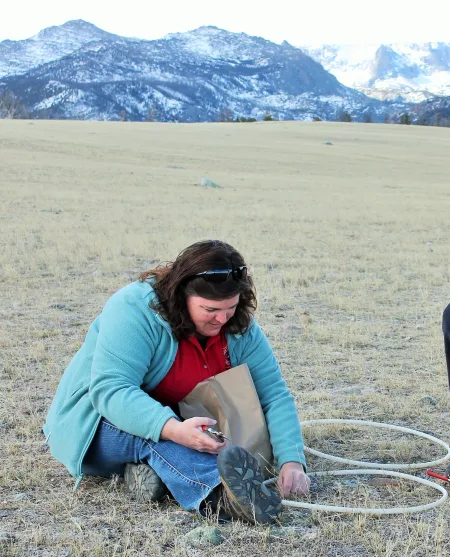
Sometimes math even helps tell stories that inspire people to care.
While working on an article about the effects of off-road vehicle travel, Amy clipped and weighed forage inside vegetation sampling hoops placed across bighorn sheep winter range. She converted grams of forage into pounds per acre, then calculated how much vegetation is flattened by just one mile of ATV tracks. The result surprised even her: one set of tire tracks can remove enough forage to feed a bighorn sheep for 21 days.
"Doing that made it tangible," Amy explains. Instead of sharing abstract numbers, she could help people picture exactly what their choices meant for wildlife.
Although math is woven throughout her work today, Amy didn't always think of herself as someone who naturally understood it.
In high school, Amy began arriving at school early every morning to spend time in Mrs. Holmen's classroom. They worked through math problems together, talked with friends, and built a relationship that lasted long after graduation. Those early mornings weren't just about math. They were about Amy learning that asking for help wasn't a sign of weakness. Mrs. Holmen believed in Amy and inspired her to take every math class her school offered.
Education researcher Linda Darling-Hammond has documented what Amy experienced firsthand: that the relationship between a teacher and student is one of the most powerful forces in learning. Not the curriculum. Not the textbook. The person who opens the classroom early and says, without words, "You belong here."
Years later, when Amy returned home from serving in the Peace Corps, Mrs. Holmen invited her back to substitute teach her math classes. "I think it's because she saw something in me," Amy says.
That relationship became the first of many adults who changed the direction of Amy's life.
Later, while taking a break from college to earn money, Amy joined the Montana Conservation Corps. There, a crew leader introduced her to something she'd never paid much attention to before: grasses. As they worked together, he taught her how to identify different species and introduced her to careers that combined rangeland science and wildlife conservation. For the first time, Amy realized a job like hers even existed.
Looking back, she says her career wasn't built by luck alone. “It was a lot of just really good people," she says. "People gave me chances." While quick to credit others, the thread running through every relationship is Amy showing up—early mornings, Peace Corps, Conservation Corps, Riverton classrooms year after year.
Today, Amy has become that person for hundreds of Wyoming students. Each year she visits Riverton Middle School, carrying bags filled with freshly clipped grass and a collection of vegetation sampling hoops (that look quite like hula hoops!). Together, students calculate how many pounds of forage grow on an acre of land and explore how many bighorn sheep that landscape can support through the winter.
“The story we tell about math — that it's finite, abstract, disconnected from real life — falls apart the moment you see Amy Anderson hold up a vegetation hoop and ask a sixth grader in Riverton what they think it means,” WYEN Program Associate Emiliy Vercoe notes. “Math, it turns out, has always been a way of paying attention to the world."
For many students, especially those who ranch or hunt, the lesson may feel familiar. The math isn't just numbers on a worksheet. It's about the landscapes they know. It's about wildlife they recognize. And it's about solving real problems that matter in their own community. Education scholar Gloria Ladson-Billings calls this culturally responsive teaching — the practice of connecting academic content to students' lived experiences and community knowledge. For a sixth grader in Riverton who has spent weekends hunting with their family, calculating forage on bighorn sheep winter range isn't abstract. It's home.
Activity Resource: Wyoming Game & Fish Inquiry Project Lesson Plan
Her story is a reminder that math doesn't have to stay inside a classroom. It can live in the forest, on the range, and across Wyoming's wide-open landscapes. It helps restore habitat, guide conservation decisions, and tell stories that help communities understand the world around them.
It's also a reminder that adults may never fully realize the impact they have.
A teacher who opens a classroom early. A mentor who points out the names of grasses. A colleague who invites a wildlife biologist to teach sixth graders. Years later, those small acts continue to grow like the tiny bitterbrush seedlings taking hold in Red Canyon.
Sometimes the most important thing we measure isn't just acres, budgets, or forage. Sometimes it's the confidence we help to grow in someone else.
WYEN’s Uncommon Math Heroes Series is supported in part by the STEM Next Foundation and Project R³, a project designed to strengthen math relationships, relevance, and real-world application across the out-of-school-time (OST) field. Math is more than a school subject. It’s a life skill that unlocks educational pathways, career options, economic mobility, and problem-solving abilities that young people need in their everyday lives.
Back to all articles

