

There’s nothing quite like the simple exhilaration offered by a swing set. Once put in motion, you fly into the sky propelled by your own momentum. Did you know that a swing is also a math problem solver?
Jason Campbell remembers working with his daughter on a difficult math problem. The solution wasn’t appearing easily. He told her, “Don’t get frustrated by it. Take a little break and come back and reattack it from a different angle.” Instead of staying stuck, she took a break. She went to the swing set and let her mind wander. A few minutes later, she returned with a fresh perspective and a pencil.
For Jason, persistence and problem-solving go hand in hand. He graduated from the U.S. Air Force Academy, became a pilot, and now flies for FedEx. He also manages the Wolf Hotel in Saratoga, a business that has been part of the community since 1893. His work has taken him from the cockpit to the hotel kitchen, from budgets and menu prices to mentoring his four children.
Through all of it, math keeps showing up.
At the Wolf, math is part of the everyday work of keeping a business running. Jason and his family compare prices from suppliers, track inventory, consider payroll and benefits, and calculate the cost of everything that goes into each menu item. The small things add up. “It’s not that it’s complicated math,” Jason said. “It’s more of oversight and awareness.”
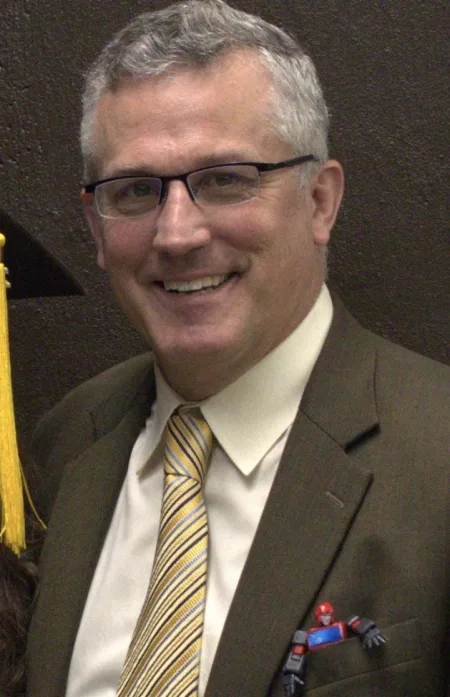
In the air, pilots use math when considering weight and balance, fuel, distance, speed, wind, and altitude. They must constantly make calculations and adjust when conditions change. Jason explained that flying is a three-dimensional experience while driving is a two-dimensional experience. He noted, “We always say that you can't pull over to the side of the road in an airplane. If something goes wrong in three dimensions, you have to get back to a two-dimensional space before you're happy again.”
Driving across Wyoming offers many surprising math problems. Do you need to plan a trip from Saratoga to Laramie? Algebra comes in handy! Use rate × time = distance to figure out how long the drive will take. Want to understand why road conditions matter? Jason has a formula, and a story, for that as well. He was once driving in wet and windy conditions when he was blown off the road. After regaining his bearing, he called his wife, D’Ron. She quipped: “What’s nine times the square root of your tire pressure?” As a mechanical engineer and fellow pilot, the formula for hydroplaning speed immediately popped into her mind.
Jason’s relationship with math has not always been easy. He arrived at the Air Force Academy with gaps to fill and had to take remedial math classes. His response: “Just kind of grind it out. Ask for help.” That response — simple, unsentimental, and completely practical — is the advice Jason has carried forward. Not "push through alone." Not "figure it out." Ask for help.
For a young person who has learned to read struggle as a signal of failure, that reframe can change everything. Research by psychologist David Yeager suggests that when young people understand that struggle is a normal part of learning — not a sign they don't belong — they are more likely to persist and seek support.
His experience at the Air Force Academy shaped the advice he gives young people today.

A difficult problem is not proof that you are bad at math. It may simply be proof that you haven't found the right explanation yet. That's not a math problem. That's a search problem, and searches have answers. Sometimes struggling is a sign that you need more time, more practice, or a different way of seeing the problem. As a flight instructor in the Air Force, Jason saw that sometimes a student doesn’t respond to an instructor’s approach. So when his kids felt stuck, he encouraged them to seek help. Ask the teacher to explain the problem differently, go to another teacher, ask a librarian, or search YouTube. “Find somebody else to tell them differently,” Jason said. “Switch an instructor. Try a different instructional technique.”
For young people, that can be a powerful message. You are allowed to ask for help. You are allowed to need a different explanation. You are allowed to try again. And adults can help make that easier.
“Across Wyoming, the people who've built the most interesting lives share something in common,” said WYEN Program Associate Emily Vercoe. “They learned, at some point, to ask for help. Not because they were struggling more than everyone else. Because they were paying closer attention."
When a young person seems checked out, it can be tempting to assume that they’re not interested. Jason’s experience suggests another possibility. They may be struggling and simply do not know how to ask for help.
Jason’s path is a good reminder that young people do not always know where their interests will lead. He grew up loving airplanes and he became familiar with the Air Force Academy by watching the football team play against the University of Wyoming. In high school, he connected with an Air Force Academy liaison officer and decided to apply.
While Jason didn’t have a perfectly mapped-out plan, he followed his interests and took a next step. His dad encouraged him to leave Wyoming, experience the world and then decide whether he wanted to return. Years later, he did.
Today, Jason’s life looks very different from what a teenager might have imagined. He is a pilot, business owner, parent, community investor, and mentor. His story is a reminder that young people are still discovering the size of the world in front of them. Families, teachers, and other caring adults can help expand that view by connecting young people to people, places, ideas, and experiences that spark their curiosity.
Sometimes that spark becomes a career. Sometimes it becomes a lifelong interest. And sometimes it simply teaches a young person that there is more than one way to solve a problem.
Jason’s advice about math is really advice about learning. And it’s advice for life. Psychologist Carol Dweck's research on growth mindset found that students who believe their abilities can grow through effort and support outperform those who believe ability is fixed — even when their starting skills are identical. Jason didn't know the research. He just lived it. When he hit a wall at the Academy, he didn't conclude he wasn't cut out for it. He found another angle.
If a young person is frustrated, don’t rush to rescue them with the answer. Help them see that mistakes and struggle are part of learning. If they are stuck, encourage them to ask for help. If one explanation is not working, find another. And if they just need a break, let them go to the playground, find a swing, feel the wind in their face, and come back with a fresh perspective.
WYEN’s Uncommon Math Heroes Series is supported in part by the STEM Next Foundation and Project R³, a project designed to strengthen math relationships, relevance, and real-world application across the out-of-school-time (OST) field. Math is more than a school subject. It’s a life skill that unlocks educational pathways, career options, economic mobility, and problem-solving abilities that young people need in their everyday lives.
Back to all articles

