

Most people would see a tangled horse halter and reach for patience. Lainie McElwee saw a Möbius strip. One afternoon, while untwisting a grazing muzzle for one of her horses, she remembered a lesson from childhood. The way the straps had twisted reminded her of a mathematical shape with only one side and one edge. Instead of feeling frustrated, she found herself thinking through the problem like a puzzle.
That moment captures how Lainie sees math as a way to understand the world around her.
Learn about the Uncommon Math Heroes Community of Practice. The deadline to apply is October 12!
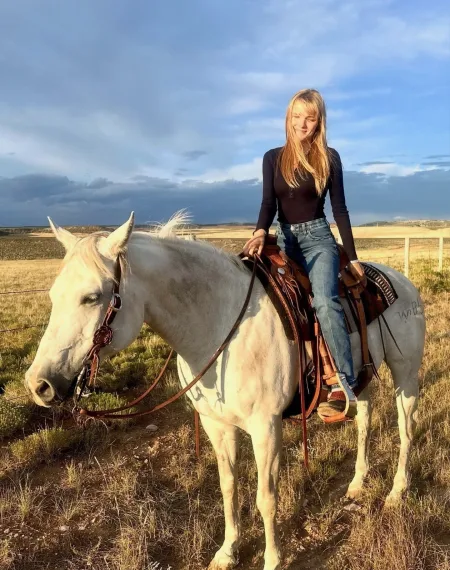
The Laramie native is a community volunteer, a student, a commercial pilot, an equestrian, and served as Miss Rodeo Wyoming 2022. Lainie is straightforward about her relationship with math: it wasn't her favorite subject. By the time she graduated from high school, she worried that she had gaps in her learning would limit what she could do next. She commented, "I don't want [math] to be the reason I don't do something."
Lainie doesn't see difficult goals as reasons to quit. She sees difficult goals as mountains: “When it comes to trying those really difficult things, take a step back. Even if it is a really tough mountain, you can still take it step by step.” She explained: “Break it down into smaller pieces and take your time. You don't have to do anything right away. You don't have to do anything as fast as your peers. You don't have to get the same grade as your peers. And you're still on your own pace doing your own thing.”
A friend who earned a computer science degree became an unexpected mentor. When Lainie told him that she couldn't succeed in computer science classes that included challenging math, her friend responded with a simple question: "Why not?" That question challenged the story Lainie had been telling herself. She realized that people who are good at math weren’t necessarily extraordinary individuals with intrinsic abilities. She realized that "people who go do those hard things are very much normal people. And I can do those things as well."
That change in mindset led to action. Rather than avoiding the classes she feared, Lainie sought help. She found a program that helped her cover concepts she had missed. She spent time learning and filling in the gaps before enrolling in calculus.
Long before calculus, Lainie was practicing perseverance through 4-H. She excelled in everything from Pocket Pets to the Horse Show. "I hated the record book every single year," she laughs. "But looking back, that was me learning to slow down, pay attention, and actually document what I was doing. I didn't know that was a skill I'd put to use." Making the effort to reflect on her experiences, organize her thoughts, and document what she learned helped her hone the skills she relies on today.
Lainie's story reminds us that encouragement isn't always about giving answers. Sometimes it's helping young people question limiting beliefs, introducing them to people who have walked the path before them, and making it normal to ask for help. Lainie's advice is to consider perspective: “Maybe the mountain is not as big as you're imagining it. It's how you choose to look at it.”
As a pilot, Lainie uses her math skills to calculate fuel consumption of a light aircraft traveling across the state, weather conditions, and aircraft performance. On the ranch, she figures grazing rates and feed requirements for her livestock. When she thinks about future careers in finance and real estate development, she sees math as the tool that can turn ideas into reality.
"Across Wyoming, young people are doing exactly what Lainie did — discovering that math shows up in the things they already love, whether that's agriculture, coding, construction, or the arts. The barrier isn't ability. It's often the story we tell ourselves about who math is for."
Lainie wishes more young people experienced math as something connected to their interests. That's why she encourages young people not to avoid something simply because it feels difficult. Lainie reflected, "The best things in life are often the things that are hard."
Today, Lainie's story isn't really about becoming good at math. It's about refusing to let difficulty decide what's possible. That same instinct, to show up, dig in, and build something, runs through everything Lainie does. Just this summer, she volunteered with the Trail Fairies to build and maintain multi-use pathways, has interned with the City of Laramie Planning Department, and is actively organizing community projects with Laramie Strong Towns. "Everything that's good is going to be hard," she said. "Just because it's hard, and it's not coming naturally to you, doesn't mean it's something you should completely write off."
WYEN’s Uncommon Math Heroes Series is supported in part by the STEM Next Foundation and Project R³, a project designed to strengthen math relationships, relevance, and real-world application across the out-of-school-time (OST) field. Math is more than a school subject. It’s a life skill that unlocks educational pathways, career options, economic mobility, and problem-solving abilities that young people need in their everyday lives.
Back to all articles

